On 3rd May 2018, I was thinking about philosophy, about how we know if some statement is true. I know I was doing that because I wrote in my journal. I was not thinking about the birth of a girl in Gaza that day, as I knew nothing about her or her family then. The girls’ name was Hind Rami Iyad Rajab. How do I know that? Through information found online. And, through an art exhibition about her held in Dundee on April 21st this year, in the city square. I know the exhibition happened because I was there.
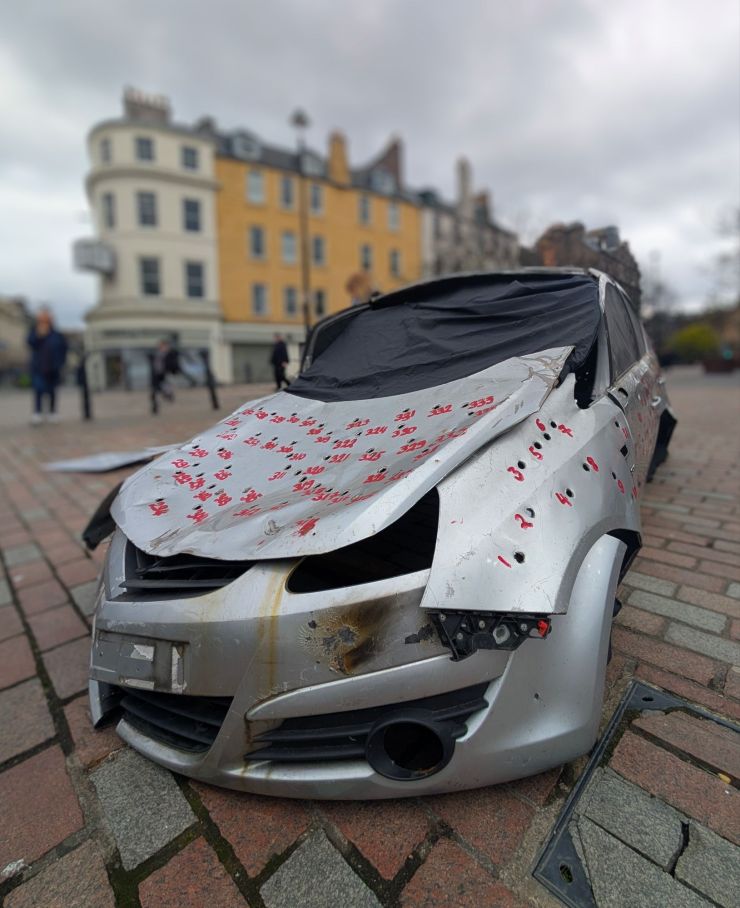
The chassis of a grey, battered car without wheels is an unusual sight in the centre of Dundee. The chassis was riddled with bullet holes, numbered in red – 335 bullet holes, to be precise. It was a replica of a real car in a real incident – a murder, in Gaza, on 29th January 2024. On that day, soldiers of the Israeli Defence Forces killed Hind Rajab, who was 5 years and 8 months old. The soldiers also shot and killed another six members of her family who were in the car. And, when an ambulance drove up to try to save people, the IDF shot and killed two paramedics.
On the day of the exhibition, I wandered towards the centre of town, but I didn’t go to the square at first, because I was worried how I’d react to the car with the bullet holes. I went to a café and sat and considered what I was about to look at. I knew the artist was called Doug Crabtree, but I knew nothing else about him. I knew a few facts about the murder of Hind Rajab, from newspaper articles and online media. I told myself, not out loud but in my head, that the exhibit wasn’t the real thing. It isn’t the car where the little girl and her family were killed. It’s a replica. But I’d seen photos of the replica and it looked real to me. And, like the many images of real scenes I had seen, of Gaza homes and hospitals bombed into ash, it made me feel sad. Sad and angry.
Eventually, I walked out of the café and a short distance to the square. I looked at the car with the bullet holes numbered in red, and I felt sadder and angrier. I went away shortly after to another café, and I wrote the following words:
‘It is 10.38 am. I went to see the exhibition, took a few photos, and tried to read the story on a laminated card, but it was too upsetting, although I already knew what the story was. I chatted with other activists and then I decided to go away and come back later. Before I left, a group of around a dozen secondary school pupils arrived. They stared at the car in silence for several minutes.’
I went back to the square later, but I didn’t stay long. I ended up in another café, writing another note.
‘Around 1 o’clock, I returned to the exhibition. It had been a cloudy day, a few hours ago, but now is sunny. The streets are busy. Some people walked by without apparently noticing the replica car riddled with replica bullet holes. A small group laughed as they passed by, walking a large dog. They did not see the car. Trade unionists milled around, staring at the exhibition. One woman looked on the verge of tears. She shook herself a little, as if she was trying to change direction emotionally, and not cry.’
The trade unionists I’d seen were attending the annual conference of the Scottish Trade Unions Congress, in the Caird Hall, a large building on one side of the city square. Throughout the day, small groups, or larger groups at lunchtime, wandered over the big square to view the exhibition. I noticed how the men and women from the conference approached the car confidently, often still discussing important issues. They all know about Palestine – in the workers movement, Palestine is an important issue. When the group of trade unionists I saw reached the car, they stood silently staring, just as the school pupils had done earlier. Staring at the car and at the 335 bullet holes marked with red numbers. I wondered if any of those men and women tried, as I did, to control what they felt, by saying inside: ‘it’s not real’. The way we’ve all done perhaps, watching a particularly horrific scene in a movie. We think then that the blood or wounds aren’t real and no one really died. As we try to slow down the real beating of our hearts.
On my third and last visit to the exhibition that day, I spoke to a woman I know who campaigns for the Palestinian cause. She told me about a man who earlier walked by the car and muttered that the people who were killed “brought it on themselves”. When he was challenged to say if that included the child, he said “yes”. We were not surprised at his attitude. The woman and myself have faced dozens of men who hold such opinions – far-Right anti asylum protesters.
It is through political action that solutions to wars and murders happen. Justice for Hind Rajab, peace and freedom for the Palestinian people will happen through politics. Through the actions of millions of people. In that vast domain, it is not always easy to see what is real and what is not. Every day, in newspapers, on TV, and online, versions of ‘reality’ are put forward which are not real. Peaceful protesters are called terrorists. Mass murderers are called peaceful.
The car with bullet holes – the replica car with replica bullet holes – is not the real car where people died. It points however to facts about murders which make most of us so sad it is hard to look at that reality. Art helps us to be able to look, and sometimes, despite sadness and even through our tears, we have to look, because we need to care about other people. We need to care about Hind Rajab as if she were our own child. And, in a way she is – she is a child of humanity, who deserves respect and remembrance. Hind Rajab had moments of joy in her short life, and you can see that fact in the brightness of her eyes in photographs. The many other children who were killed in the bombing of Gaza were the same.
We who remain on this bruised and battered planet, amongst so much wreckage, anger and sadness, need to build a world where all children are free. Free from bombs and free from the threat of bombs. Free from real terror. Free to live.
In recent months, in cities across Scotland, far-Right men who made weak excuses for their racist hatred, tried to terrorise asylum seekers and refugees. The far-Right men screamed at people like me and at many others who defended asylum seekers. We see all of our newest neighbours as people who deserve peace, often after fleeing wars. Men, women, children. Sometimes, a man or woman on our side would carry a Palestinian flag. The far-Right men would scream: “What’s that got to do with Scotland?” The answer was always simple – everything. Any person anywhere in the world who does not care about the suffering of others in this world is denying the right to live for other members of our human family. That has everything to do with the sort of Scotland most of us want to live in. All people, all children matter, wherever they were born. We will build a world where peace and hope for all is real.
 HARVEY DUKE