
It was quiet in the café in Dundee. Not entirely silent – I could hear faint hissing and gurgling sounds from the cafes’ kitchen, somewhere behind where I was sitting. Yet, it was quiet enough that I felt calm, and I was able to let impressions of a noisier but pleasant weekend in Glasgow play around in my head. The main event of the weekend was a 60th birthday party, in the basement of a pub. A few dozen folk chatting, laughing, and sometimes dancing. I sat in one corner with Isobel, reminiscing. And, I had conversations with others, where you had to speak closely and loudly to be heard above the other voices and music. There was a steady flow of alcohol, which I didn’t join in with, having lost the alcohol habit years ago; but as people around me got louder and happier, I didn’t feel left out or awkward, the way I would have if I’d become tense. I was so relaxed I became slowly inebriated on the sights and sounds around me.
I came back down to earth from the high of those memories, but I continued to feel a buzz of excitement as I sat in the mostly empty Dundee café. An open notebook in front of me, my pen moving almost by itself, as I wrote down impressions. An old police box, converted into a hemp shop, on a busy street in Glasgow. A small bookshop with that special glow of packed bookshelves, where Isobel bought me a two-volume set of Vintage Thurber. And, at night, Isobel turning to look at me as we danced, and she smiled and I felt as happy as one distant day in St Andrews when the sky was the purest blue of any sky I’d ever seen, and the river was glittering with silver stars.
So, there I was in the cafe, scribbling away. In a daze, or reverie, or whatever. On the table in front of me, I had a clock on my phone: electronic, but with the image of a mechanical clock, with a circle of numbers, two hands displaying the time, and a slimmer minute hand, moving slowly around the dial. It was this minute hand which caught my attention and my imagination. First, I should try to describe the way it was moving. The minute hand pointed to a small mark on the dial, like the marks on a ‘real’ clock or watch. The hand paused for a moment, and then flicked in an instant to the next mark. Pause, flick. Pause, flick. Tick. Tick. And during each second shown as passing by, I became aware of my changing surroundings. Outside the cafe on a walkway of the Overgate Shopping Centre, I saw people passing. A man walked by slowly; a woman walked by briskly; a small child toddled a short distance near the cafe, and then stood looking at her reflection in a window. Some people who walked by seemed sad, others were laughing, some swung their arms, and some glanced towards me or stared firmly ahead. Within a few seconds, each person was gone. Time passing. People – clearly visible as they walked by, for a few seconds, and then, just as clearly- they were not there. And I remembered – this always fascinated me: the passing of time. And I thought – where do moments so bright and so full of life go? I see a face, a smile, a couple walking hand in hand, and then they go. How can all those vivid moments instantly become nothing?
Over many years, I made efforts to try to understand time better. As well as watching clocks (particularly, when I worked in a factory!) I read a great variety of books, stories, and articles, which explored the idea of time. Science, science fiction, and other literature, where the writer was fascinated by time. Hundreds of thousands of words, a few million perhaps; certainly, millions of seconds of trying to understand time. In all those efforts, I recall only a handful of moments when I thought I saw a glimmering of a clear understanding of time. Yet, whenever I tried to put this understanding into my own words, it faded away, like the last sparks of a small fire on a beach in Fife. And all that was left was a cold, vast night sky above me, with thousands of bright stars. And no answers.
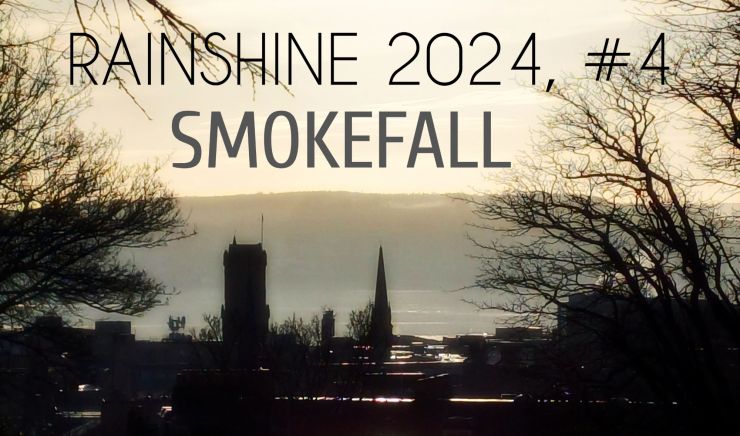
One kind of answer about time, one glimmer which I returned to again and again, can be found in the poetry of TS Eliot, particularly a set of poems published during the Second World War, called Four Quartets. In the first of these poems, Burnt Norton, there is a word which Eliot invented: smokefall. It is often assumed to refer to the moment when twilight fades into night. I didn’t know what it meant when I first read it, and I’m not entirely sure now, but I feel that this one word, more than any other, binds together something of the essence of time, and the power of language to help us to grasp what time is. Yet, as strong as this impression is, I’ve never been able to fully explain why I think of the word ‘smokefall’ in this way. The best I can do is quote the lines in Eliot’s poem where the word appears, and I’ll offer a little commentary. The lines are:
To be conscious is not to be in time
But only in time can the moment in the rose-garden,
The moment in the arbour where the rain beat,
The moment in the draughty church at smokefall
Be remembered; involved with past and future.
Only through time time is conquered.
You don’t need to know much about poetry, philosophy, or psychology, to sense, when you read those words, there’s a kind of musical effect which is powerful. I experienced a similar effect listening to my mum playing Clair de Lune, by Debussy, on a piano, when I was a child. Even now, decades later, whenever I hear the same notes, I am deeply haunted by a feeling of time passing and our individual lives being very tiny and immeasurably vast at the same time. Eliot coined and used the word ‘smokefall’ to tie some of his time-reveries together. I’ve borrowed the word ‘rainshine’ to label some of my efforts to describe moments which are vivid and yet instantly pass away.
I don’t think there are ideas weirder than the reality of time passing, but storytellers sometimes play around with an idea which seems even weirder: the notion of time travel. I’m thinking of books like The Time Traveler’s Wife by Audrey Niffenegger (2003); Somewhere in Time (1975) by Richard Matheson; or Kindred (1979) by Octavia E. Butler. Or, of course, there’s also The Time Machine (1895) by H.G.Wells. I read that story a few times, and listened to an audio version, but it was a scene in the 1960 movie which stayed with me. It’s the scene when the time traveller is sitting in his mechanical time machine, which looks as exquisite as a Victorian pocket watch. Machine and man are speeding through time, and he is watching fashions change on mannequins in a shop window as decades and centuries rush by. I suspect one reason why this scene stuck in my mind is that I regularly pass clothes shops in the High Street of Dundee, which have mannequins in their windows. I sometimes find myself thinking about the changing fashions during the years in my life, although my time is moving somewhat slower than in the movie. I think about 1970s wide ties and flared trousers, and recently resurrected 1980s style velvet jackets. I don’t think they revived well, but the blue velvet jacket I had in in the ‘80s was very cool, until it fell to bits through overuse.
Not long after our weekend in Glasgow, we visited Edinburgh, and went to the big museum, with my dad. In the Scottish history section, there are five large floors, each devoted to a different era – from ancient times, with Pictish stones on display, to floors where you can see huge threadbare Jacobite flags, and the development of industry, including a working beam engine which is taller than a double-decker bus. Far too many things to see in just one visit, so we tend to look around one floor per visit. Even then, there’s a lot to take in, but you can have a rest in the cafe in the main hall. Surrounded by space and echoes, we have time to chat about the treasures we’ve seen that day. And we eat cakes, of course.
I have a habit of wandering off in the museum to take photographs. I don’t get lost – well, not for long. Isobel usually finds me and pulls me back to what we’re supposed to be looking at, like I’m a slightly naughty schoolboy. I try not to stamp my feet. Anyway, on that last visit, I wandered into an adjoining section, where there was a glass display case full of phones. The earliest trumpet like devices, and the first brick sized mobile phones, and also newer smaller devices. It made me think again about that scene in the movie of The Time Machine. Modern things becoming old things. I had the same thoughts a few minutes earlier, when I came across another display case. In it there was a large wooden cabinet with a tiny screen: one of the first television sets. The contrast with today’s vast TV screens was extreme – the smaller and larger TV’s look as if they come from centuries apart, rather than just a few decades.
Earlier that day, I was let loose, for a short time, in a second-hand book shop. I bought a 1951 book, called ‘OLD CLOCKS for modern use, with a guide to their mechanism’, by Edward Wenham. I hoped to find an explanation of how clocks measures seconds. I found that out, although I had to look at videos to see what it was telling me. The best video I watched was an 8-minute talk by Oliver Cooke, Curator of Horology at the British Museum. Standing beside a 16th century clock made almost entirely of wood, he spoke about the five elements for understanding how a clock works: Energy, Wheels, Escapement (or “the beating heart of the clock”), Controller (an internal device which governed the rate of the tick tock in very old clocks until the pendulum and later quartz took over this role) and Indicator (the dial and the hands, so that folk like us can tell the time). These five elements are given a nice memory prompt: Every Witch Eats Crunchy Insects.
The way I began to understand the movement of seconds, which had fascinated me in the cafe, was to see what the minute hand is doing. In a mechanical watch or clock, the minute hand rotates a full revolution every minute, with the seconds marked out on the dial. The slightly juddery ticking of seconds is the result of what lies beneath the dial: the way the cog wheels are turning. Pause, flick. So, the electronic version simply mimics the effect of this movement.
Back to the 1951 book, where I found a more impressionistic description of what’s going on in a clock. In Chapter 5, headed ‘The Pulse of Time’, the author states: ‘Everything that moves, either of its own volition or mechanically, has some parts of it which may be called the heart from which the impulses spring. Moreover, such things each give forth a more or less audible repetitive two-beat sound similar to that which in human and other animals is called a pulse. A steam engine will give out a puff-puff or a double sighing sound; that of a pump is similar; it can be heard in the action of a motor car piston and in other machinery.
So, with the clock, the escapement is the heart and the ‘tick-tock’ might be called the sound of the pulse.’ (p20)
In the times we live in, with electric cars and buses sailing silently by, or electronic phones and laptops with no audible ‘pulse’, it’s not easy to imagine the mechanical or created structures underlying our world. Often, things just seem to happen, almost by magic. Of course, in fact, everything is manufactured: machinery and work went into the making of every gleaming surface, every silent wonder. Nothing just happens.
Later in that day when I first noticed the slightly juddery movement of a minute hand on my phone clock, I ended up in a different café, at another part of the same shopping centre. I sat at a window, overlooking an old church, with a steeple from another church in the distance and around it a patch of pure blue sky. If I glanced away from the window and into the shopping centre, I could see a busy walkway, a row of shops, and people walking past the café. I was still vaguely thinking about time, as I casually alternated my viewing from the sunny world outside to the bright world indoors. I began to think about seconds again, passing by inside the centre and outside. On the walkway, people walked past the café, just as they had outside the other café. I watched a woman pushing a pram very quickly and very quickly she was gone. Couples, an old man, two sniggering schoolboys, all passed by. It was much busier than in the morning, so there was no lull in the numbers of people passing by. People flowed; there was a buzz of chattering. I began to think – every second, it’s like a different world. Nothing stays the same for more than a second. People moving, talking, looking around, passing by. It became tiring to watch, so I glanced out of the window. Immediately, time moved slower. The church – it’s old stone walls bright in the sun, the steeple in the distance, the pure blue sky. They all looked exactly the same this second as they had a few seconds ago, and as I gazed around the scene, nothing seemed to change. Seconds must have ticked by, but everything remained still. I glanced back into the centre: a flow of people, some individuals moving so fast they were blurs. And then looking back out to the world outside. Calm. Nothing moving. The same seconds there seemed to be frozen in time.
I meant to say something about how scientists consider time, but that’ll have to wait, for another time.
 HARVEY DUKE